PACIFIST FIGHT CLUB

We will fight for peace, but we will do no violence.

Tuesday, March 11, 2014

COUNTDOWN TO ROUND 4

Be sure to join us this Saturday, March 15 at BIOLA in the Mosaic Cultural Center for PACIFIST FIGHT CLUB - ROUND 4.


Our Fighters will be Mike Izbicki, former Naval Nuclear Submarine Officer, and Dr. Thomas Crisp, Professor of Philosophy at Biola and founder of the Dorothy Day Society.

THIS IS A FREE EVENT.


LOCATION:
Biola University
13800 Biola Ave., La Mirada, California 90639


PARKTING INFO:
The gate to Lot A will open at 7am on Saturday morning. No parking pass needed. Please park at the end of Lot A, whose entrance is separate from the main entrance of Biola. The entrance is just north of the main entrance on Biola Ave.

Location is the Mosaic Cultural Center, directly across from the new Talbot East building. Look for a glass sign outside of the building.


See you there!

Sunday, March 9, 2014

JOIN US: SATURDAY, MARCH 15 AT BIOLA FOR PACIFIST FIGHT CLUB: ROUND 4

THIS IS A FREE EVENT!

PACIFIST FIGHT CLUB | ROUND 4 - "Proactive Love"

Saturday, March 15
Mosaic Culture Center - Biola University
9am to 12pm

PARKING: 
The gate to Lot A will open at 7am on Saturday morning. No parking pass needed. Please park at the end of Lot A, whose entrance is separate from the main entrance of Biola. The entrance is just north of the main entrance on Biola Ave.

Location:
Mosaic Cultural Center, directly across from the new Talbot East building. Look for a glass sign outside of the building

Our Fighters:

*Mike Izbicki - Former Naval submarine officer who read the Sermon on the Mount and is now a conscientuous objector.

*Dr. Thomas Crisp - Co-Founder of PFC and Professor of Philosophy at BIOLA.

SEE YOU THERE!

Monday, March 3, 2014

MIKE IZBICKI: NEW YORK TIMES ARTICLE

Come meet Mike Izbicki at Pacifist Fight Club | Round 4 on Saturday, March 15 at BIOLA University.

NEW LONDON, Conn. — The question that changed Michael Izbicki’s life appeared on a psychological exam he took not long after graduating in 2008 near the top of his class at theUnited States Naval Academy: If given the order, would he launch a missile carrying a nuclear warhead?
Ensign Izbicki said he would not — and his reply set in motion a two-year personal journey and legal battle that ended on Tuesday, when the Navy confirmed that he had been discharged from the service as a conscientious objector.
In the process, Mr. Izbicki, 25, went from Navy midshipman in the nuclear submarine fleet here, studying kill ratios, to resident of a small peace community a few blocks from the Thames River, where he prays several times a day, studies Hebrew and helps with the organic garden.
He is one of only a few graduates of the nation’s military academies to be granted conscientious objector status in recent years. And while every case is deeply personal, his long struggle for an honorable discharge offers a glimpse of a rarely viewed side of military experience in the post-draft, all-volunteer era: the steep challenge facing any service member — and especially a graduate of a service academy — who signs up as a teenager to become a warrior and then changes his mind in adulthood about his willingness to kill.
The Navy fought his request hard, in much the same way that the Army contested the conscientious objector application of Capt. Peter D. Brown, aWest Point graduate and an Iraq war veteran who was discharged in 2007 after a protracted court battle.
Academy graduates accounted for only a dozen of the roughly 600 applicants for the special status between 2002 and 2010, spokesmen for the service branches said. Of those requests, fewer than half were approved. And like many of the other academy applicants, according to lawyers who handle such cases, Mr. Izbicki won his discharge only by taking his petition to federal court.
The Navy rejected Mr. Izbicki’s application twice, questioning the sincerity of his beliefs despite the support of several Navy chaplains and the testimony of twoYale Divinity School faculty members who said his religious convictions seemed to be mature and sincere.
One Navy commander suggested that the pacifist strain of Christianity that Mr. Izbicki embraced was inconsistent with mainstream Christian faith. The same commander likened the Quakers, who supported Mr. Izbicki, to the Rev. Jim Jones and his People’s Temple, a suicide cult.
J. E. McNeil, executive director of theCenter on Conscience and War, a nonprofit group in Washington that helps service members navigate the conscientious objector process, said that a case like Mr. Izbicki’s posed a profound challenge to the military. “You were someone they thought was going to be a leader,” Ms. McNeil said. “They spent four years training you. Now you want nothing to do with that world.”
**
Mr. Izbicki, a National Merit Scholarship finalist in high school, chose the naval academy at Annapolis, Md., over a bevy of colleges, including theCalifornia Institute of Technology, that offered him four-year scholarships, because he felt an obligation to serve his country during wartime, he told investigators in his application for discharge.
He grew up attending nondenominational Christian services in San Clemente, Calif., and remained a regular churchgoer during his four years at the academy, where Christianity is the dominant faith. Cadets are required in their junior year to study the “just war” theory, a doctrine justifying military action, based largely on the writings of St. Augustine and St. Thomas Aquinas.
Not until his senior year did Mr. Izbicki register a sense of unease over what he would refer to in his application as “the frankness with which people talked about killing.” He wrote: “The training did not live up to the ideals of the just war as I envisioned them. I saw formulas for calculating the number and types of casualties that would result from using each of our weapons systems. We calculated the extent of civilian casualties and whether these numbers were politically acceptable.”
***
But Mr. Izbicki said he also began exploring his commitment to Christianity. He studied the Gospels, read widely about the early history of the church, took up Hebrew so he could read the Old Testament in the original, and started to measure his faith according to the evangelical touchstone “What would Jesus do?”
It was in that light that he encountered the exam question about launching a nuclear missile in early 2009, shortly after he was assigned to submariner school at the Nuclear Power Training Command in Charleston, S.C. Seeing the question spelled out like that, he said, made it impossible to hide his emerging pacifism any longer.
“I realized that I could not be responsible for killing anyone,” he later explained.
His answer flagged him for psychological testing, and a consultation with a Navy chaplain, who was the first to suggest that Mr. Izbicki consider applying for discharge as a conscientious objector.
“I had never really heard of it,” Mr. Izbicki, a reserved, soft-spoken man, said in an interview last week atSt. Francis House, where he resides. “It was one of those things people did in the ’60s.”

Sunday, March 2, 2014

What does Christian Nonviolence and Pacifism have to do with Gender Equality?

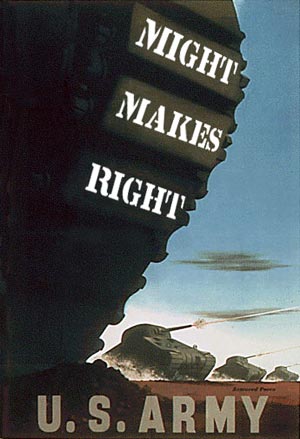
Crestock.com: Propoganda Parodies

Only the strong survive.


Might makes right.


Whoever has the gold makes the rules.


This world seems to operate on a certain set of principles. Typically, these principles imply and enforce a top-down power structure that keeps a few in control of the rest. Mythology and religious lore (and their interpreted texts) are likewise propagated by those on top and in power of cultures, communities—and their respected microcosms—creating a divine rite: baptising these structures as sacred, and thus, unarguable. And when there was an argument, ultimate decisions were (and still are) often decided through military might.  


Historically — and across almost all cultures — those on top are and have been men. Author Danny Silk describes this as the patriarchal paradigm. In his book, Powerful and Free, he says it’s the:
“Pattern of men using violence to gain and preserve power, whether political, military, economic, or sexual [...] It’s the law of the jungle that says, ‘If you threaten anything I control, I will persecute you. I will hurt you. And even kill you if I have to” (40).


Silk seems wise in his word choice here. The patriarchal paradigm is really about control, isn’t it? Not love. Not ownership or possession. But control.


Throughout the ages, women have not been in control. Sure, there are some isolated examples, or the old adage about necks controlling heads, but by and large, this women have not been calling the shots.


This traces back to the Fall. As God predicts, the result of sin is Man ruling over Woman.
Throughout the ages, this has been true and men have enjoyed the unquestioned ability to “put women in their place.”


Sometimes, this gets physical. 1.3 million women are victims of physical assault by an intimate partner each year, as estimated by the National Coalition Against Domestic Violence. Additionally, domestic violence is the third leading cause of homelessness among families (SafeHaven.org).


I recently heard someone say, “If a fish floats belly up to the surface of a lake, you ask what’s wrong with the fish; if 100 fish surface, you better start to look at the lake!”

Something stinks in the lake water we’re all floatin' in. When we begin to look at statistics like these, it’s not enough to think there are a few rotten-fish husbands. What questions should be asked of the paradigms handed to and held by men to permit this behavior?
And is physical harm the only “violence” done to women?


It seems that the administrative board of the Institute for Basic Life Principles have chosen to place their founder—conservative Christian leader, outspoken advocate of family values, and homeschooling tycoon, Bill Gothard—on leave, “while the board investigates claims that he years ago engaged in sexual harassment and other misconduct.” That investigation of misconduct comes after the public critique and testimony of over 30 women alleging that Gothard had harassed them while they worked in his ministry.


What paradigms are in play to allow a man who devotes his life to upholding family values and conservative morality to be, in his words, “physically and emotionally defrauding his personal secretary”? This is a man who lived out his faith convictions in seemingly and by all appearances every other area in his life. On the one hand, it may be easy for those of us watching from the outside to toss out or dismiss all of his Christian credibility. On the other, it’d be easy to simply look at this as one moral failure, to be excused by “grace.” A more difficult path would be to examine what perspectives lead far too many here.


In San Diego, William Lansdowne, the city’s police chief of over 10 years, stepped down this week during controversy over a number of sexual abuse cases involving officers in his charge. All of this occurred on the same day former San Diego mayor plead guilty to the sexual abuse accusations for which he left office.


Could it be that a paradigm of control permits men to perceive women—and their bodies—as entities over which their control extends? Could it be that the measure of masculinity, lived out this way, is the extent to which one might exert this control over others?


Making this out to be, simply, a “man problem” might be too narrowly defined, as San Diego is also discovering. This isn’t a matter of men, but of the paradigms that persist to communicate "Control Equals Power—and might makes right."


Further, I fear that some Christians have baptized their theology on the shores of this pagan patriarchal paradigm. So, I humbly suggest that this is the lake we begin to examine a little closer.

Over the next few posts in this series, I’ll do just that. So let me ask: what questions or insight do you have regarding nonviolence and gender equality? Is this a “fish” problem, or a “lake” problem? How have you seen the patriarchal paradigm affect the world around you?

Saturday, March 1, 2014

The Peaceable Kingdom Sermon Series - Jonathan Martin, Renovatus Church


The Peaceable Kingdom, Renovatus Church

Pastor of Renavotus Church in Charlotte, North Carolina, and author of Prototype: What Happens When You Discover You're More Like Jesus Than You Think [Zondervan, 2013], Jonathan Martin [@renovatuspastor] is preaching through a series on the Peaceable Kingdom.

Be sure to start with part 1: "The gates are never shut, and the light is never out" which applies a nonviolent lens to the book of Revelation, revealing a beautiful invitation to all, extended by the God of Love.

In part 2, Pastor Jonathan puts Jesus' heart on display, when He laments, "If you had known, even you, especially in this your day, the things [that make] for your peace! But now they are hidden from your eyes." [Luke 19:42 NKJV, emphasis added]. Martin juxtaposes the hells we create on earth to the kingdom we are called to—on earth, as it is in heaven.

Hailing from Honduras, JC Gomez recounts his conversion experience—to a reconciling God, from a life of violence—in part 3, "The Great Feast." Jonathan Martin highlights that this "Great Feast" of the King of an upside down kingdom who invites all to this feast, not just soldiers and the elite celebrating the spoils of war.

Find the sermon series here.

Thursday, February 27, 2014

PERFECT SOLDIERS


How Corporate and Military Exploitation Work Hand In Hand To Exploit The Poor.