PACIFIST FIGHT CLUB

We will fight for peace, but we will do no violence.

Sunday, March 2, 2014

What does Christian Nonviolence and Pacifism have to do with Gender Equality?

Crestock.com: Propoganda Parodies

Only the strong survive.


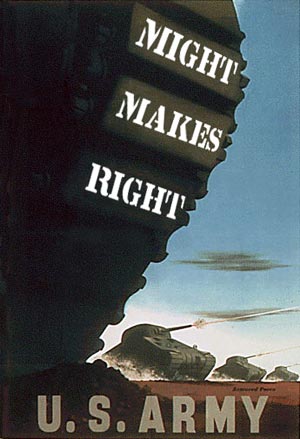
Might makes right.


Whoever has the gold makes the rules.


This world seems to operate on a certain set of principles. Typically, these principles imply and enforce a top-down power structure that keeps a few in control of the rest. Mythology and religious lore (and their interpreted texts) are likewise propagated by those on top and in power of cultures, communities—and their respected microcosms—creating a divine rite: baptising these structures as sacred, and thus, unarguable. And when there was an argument, ultimate decisions were (and still are) often decided through military might.  


Historically — and across almost all cultures — those on top are and have been men. Author Danny Silk describes this as the patriarchal paradigm. In his book, Powerful and Free, he says it’s the:
“Pattern of men using violence to gain and preserve power, whether political, military, economic, or sexual [...] It’s the law of the jungle that says, ‘If you threaten anything I control, I will persecute you. I will hurt you. And even kill you if I have to” (40).


Silk seems wise in his word choice here. The patriarchal paradigm is really about control, isn’t it? Not love. Not ownership or possession. But control.


Throughout the ages, women have not been in control. Sure, there are some isolated examples, or the old adage about necks controlling heads, but by and large, this women have not been calling the shots.


This traces back to the Fall. As God predicts, the result of sin is Man ruling over Woman.
Throughout the ages, this has been true and men have enjoyed the unquestioned ability to “put women in their place.”


Sometimes, this gets physical. 1.3 million women are victims of physical assault by an intimate partner each year, as estimated by the National Coalition Against Domestic Violence. Additionally, domestic violence is the third leading cause of homelessness among families (SafeHaven.org).


I recently heard someone say, “If a fish floats belly up to the surface of a lake, you ask what’s wrong with the fish; if 100 fish surface, you better start to look at the lake!”

Something stinks in the lake water we’re all floatin' in. When we begin to look at statistics like these, it’s not enough to think there are a few rotten-fish husbands. What questions should be asked of the paradigms handed to and held by men to permit this behavior?
And is physical harm the only “violence” done to women?


It seems that the administrative board of the Institute for Basic Life Principles have chosen to place their founder—conservative Christian leader, outspoken advocate of family values, and homeschooling tycoon, Bill Gothard—on leave, “while the board investigates claims that he years ago engaged in sexual harassment and other misconduct.” That investigation of misconduct comes after the public critique and testimony of over 30 women alleging that Gothard had harassed them while they worked in his ministry.


What paradigms are in play to allow a man who devotes his life to upholding family values and conservative morality to be, in his words, “physically and emotionally defrauding his personal secretary”? This is a man who lived out his faith convictions in seemingly and by all appearances every other area in his life. On the one hand, it may be easy for those of us watching from the outside to toss out or dismiss all of his Christian credibility. On the other, it’d be easy to simply look at this as one moral failure, to be excused by “grace.” A more difficult path would be to examine what perspectives lead far too many here.


In San Diego, William Lansdowne, the city’s police chief of over 10 years, stepped down this week during controversy over a number of sexual abuse cases involving officers in his charge. All of this occurred on the same day former San Diego mayor plead guilty to the sexual abuse accusations for which he left office.


Could it be that a paradigm of control permits men to perceive women—and their bodies—as entities over which their control extends? Could it be that the measure of masculinity, lived out this way, is the extent to which one might exert this control over others?


Making this out to be, simply, a “man problem” might be too narrowly defined, as San Diego is also discovering. This isn’t a matter of men, but of the paradigms that persist to communicate "Control Equals Power—and might makes right."


Further, I fear that some Christians have baptized their theology on the shores of this pagan patriarchal paradigm. So, I humbly suggest that this is the lake we begin to examine a little closer.

Over the next few posts in this series, I’ll do just that. So let me ask: what questions or insight do you have regarding nonviolence and gender equality? Is this a “fish” problem, or a “lake” problem? How have you seen the patriarchal paradigm affect the world around you?


Saturday, March 1, 2014

The Peaceable Kingdom Sermon Series - Jonathan Martin, Renovatus Church


The Peaceable Kingdom, Renovatus Church

Pastor of Renavotus Church in Charlotte, North Carolina, and author of Prototype: What Happens When You Discover You're More Like Jesus Than You Think [Zondervan, 2013], Jonathan Martin [@renovatuspastor] is preaching through a series on the Peaceable Kingdom.

Be sure to start with part 1: "The gates are never shut, and the light is never out" which applies a nonviolent lens to the book of Revelation, revealing a beautiful invitation to all, extended by the God of Love.

In part 2, Pastor Jonathan puts Jesus' heart on display, when He laments, "If you had known, even you, especially in this your day, the things [that make] for your peace! But now they are hidden from your eyes." [Luke 19:42 NKJV, emphasis added]. Martin juxtaposes the hells we create on earth to the kingdom we are called to—on earth, as it is in heaven.

Hailing from Honduras, JC Gomez recounts his conversion experience—to a reconciling God, from a life of violence—in part 3, "The Great Feast." Jonathan Martin highlights that this "Great Feast" of the King of an upside down kingdom who invites all to this feast, not just soldiers and the elite celebrating the spoils of war.

Find the sermon series here.

Thursday, February 27, 2014

PERFECT SOLDIERS


How Corporate and Military Exploitation Work Hand In Hand To Exploit The Poor.

Wednesday, February 26, 2014

WHY IS THE CHRISTIAN PEACE MOVEMENT SO SMALL?

Thoughts from the blog of Tim Suttle: 

Why is the Christian peace movement so small? Why are so many Christians willing to engage in a search and destroy mission around issues like homosexuality (upon which Jesus did not comment), or insistent upon adherence to Jesus’s teaching on divorce, and yet so willing to ignore the clear command to “love your enemies,” that is part of the very same chapter of Matthew as the divorce teaching?
For most of us as evangelicals, the faith of our fathers and grandfathers did not include any kind of strict adherence to Jesus’s teaching on violence. Christian non-violence was never mentioned as a possibility in my Southern Baptist upbringing. In fact Matthew 5:38-48 remained indeterminate in all of my discipleship and training until I ran into Stanley Hauerwas, John Howard Yoder, as well as many of my professors and fellow students at seminary. That Jesus’s teaching on non-violence is so largely ignored or misunderstood in the general culture has to be at least part of the reason Reza Aslan’sZealot could become a best seller. Anyone steeped in the tradition of Christian non-violence would quickly point out the way Aslan completely ignored huge swaths of Jesus’s life and teaching, especially the way that non-violence is essential to a Christian understanding of the gospel.
The obvious exception to this would be the Anabaptists. I often think that God preserved two important doctrines among the Anabaptist people. The first is the gospel of the kingdom of God (as opposed to a gospel of sin management & how to get into heaven when you die). The second is the doctrine of Christian non-violence. The Anabaptists are now powerfully and prophetically teaching the rest of us these essential doctrines to the wider church.
Stanley Hauerwas often says that Christians are not committed to non-violence because they think it will be an effective strategy to rid the world of war. Christians are committed to non-violence because they cannot imagine any other way to live in light of the life, teaching, death, and resurrection of Jesus. I find it ironic, then, that for the most part the opposite is true. Most Christians in our society cannot imagine livingnon-violently in such a violent world. We have no imagination for what it might mean to respond to our dog eat dog world by turning the other cheek, offering our cloak & tunic, and going the extra mile. I had been following Jesus for at least twenty-five years before anyone challenged my thinking in regard to violence and war and Jesus’s teaching on the matter.

Tuesday, February 25, 2014

[Subversive Radio Podcast] NOT PEACE BUT A SWORD?

Why did Jesus say he came "not to bring peace, but a sword?" if he really expected us to embrace peacemaking?

Keith Giles explains in this special [Subversive Radio Podcast].


Monday, February 24, 2014

Where Does God's Kingdom Come From? by Josh Lawson


There has never been a mightier man to walk the earth than Jesus of Nazareth. His moral, emotional, and spiritual strength was unparalleled by anyone of his day. It remains unmatched to this hour.
Yet his message was unequivocaly one of non-violence.
The first three centuries of Christian history following his advent into the world attest to the fact that the overwhelming majority of those who first followed in Christ’s way upheld this conviction of non-violence with great passion. Soldiers abandoned their posts upon coming to the Lord. They refused military service. When struck upon one cheek they offered the other.
This practice only began to change with the unholy alliance of church and state under Constantine in the third century. What little evidence there is to suggest otherwise is not difficult to refute. Keith Giles has written an article recently that explores this notion in more detail, which I highly recommend you read.
Even still, living in America today it is hard to refute Gandhi’s painful observation: “The only people who don’t see Jesus and his teachings as non-violent are Christians!”
WHY CHRISTIANS FIGHT
What is the reason for this quandary? It is simple, really.
Under interrogation by Pilate Jesus said, “My kingdom is not of this world. If my kingdom were of this world, my servants would have been fighting, that I might not be delivered over to the Jews. But my kingdom is not from the world” (John 18:36).
Note that Jesus’ disciples did want to fight to keep him from being handed over. This is because, like Jesus said, they still thought his kingdom was of and from the world. Right up to the moment of his ascension they were still clinging to this belief (see Acts 1:6).
Also note that there is a difference between God’s kingdom being from the world and its being for the world. Just because His kingdom is not of the world does not mean it is not for the world. On the contrary, it is. This simply goes to show that it is not advocating any form of spiritual escapism to proclaim that God’s kingdom is not of this world.
So why did Jesus’ disciples want to fight? Why did Peter draw his sword and cut off one man’s ear? Simply because they thought their Rabbi’s kingdom was of the world.
And why do some of Jesus’ followers still want to fight today? Why do they support war and the military industrial complex? For the same reason. There remains a widescale confusion as to where God’s kingdom is coming from. Nevertheless,
God’s kingdom is not coming from a world where men fight to overthrow regimes and establish new orders. God’s kingdom is coming from heaven where the battle is won by a Lamb laying down his life.
SOMETHING WAS DIFFERENT 
So it would do us well to take a fresh look at the words of Jesus. If you’re not sure where you stand in regards to this issue you may want to consider the testimony of the first three centuries of Christian history prior to Constantine. Something was different, and you owe it to yourself to find out what that something was.
There was a reason Celcus said of the Christians: “If everyone were to act the same as you, the national government would soon be left utterly deserted and without any help, and affairs on earth would soon pass into the hands of the most savage and wretched barbarians.”
There was a reason Martin of Tours proclaimed: “I am Christ’s soldier, I am not allowed to fight.”
There was a reason Tertullian declared: “When Christ disarmed Peter, he disarmed every soldier.”
Behind all these words there is a deep and positive reality, and you can be sure it is not any form of cowardice or escapism. The pen may be mightier than the sword, but the cross is mightier still.